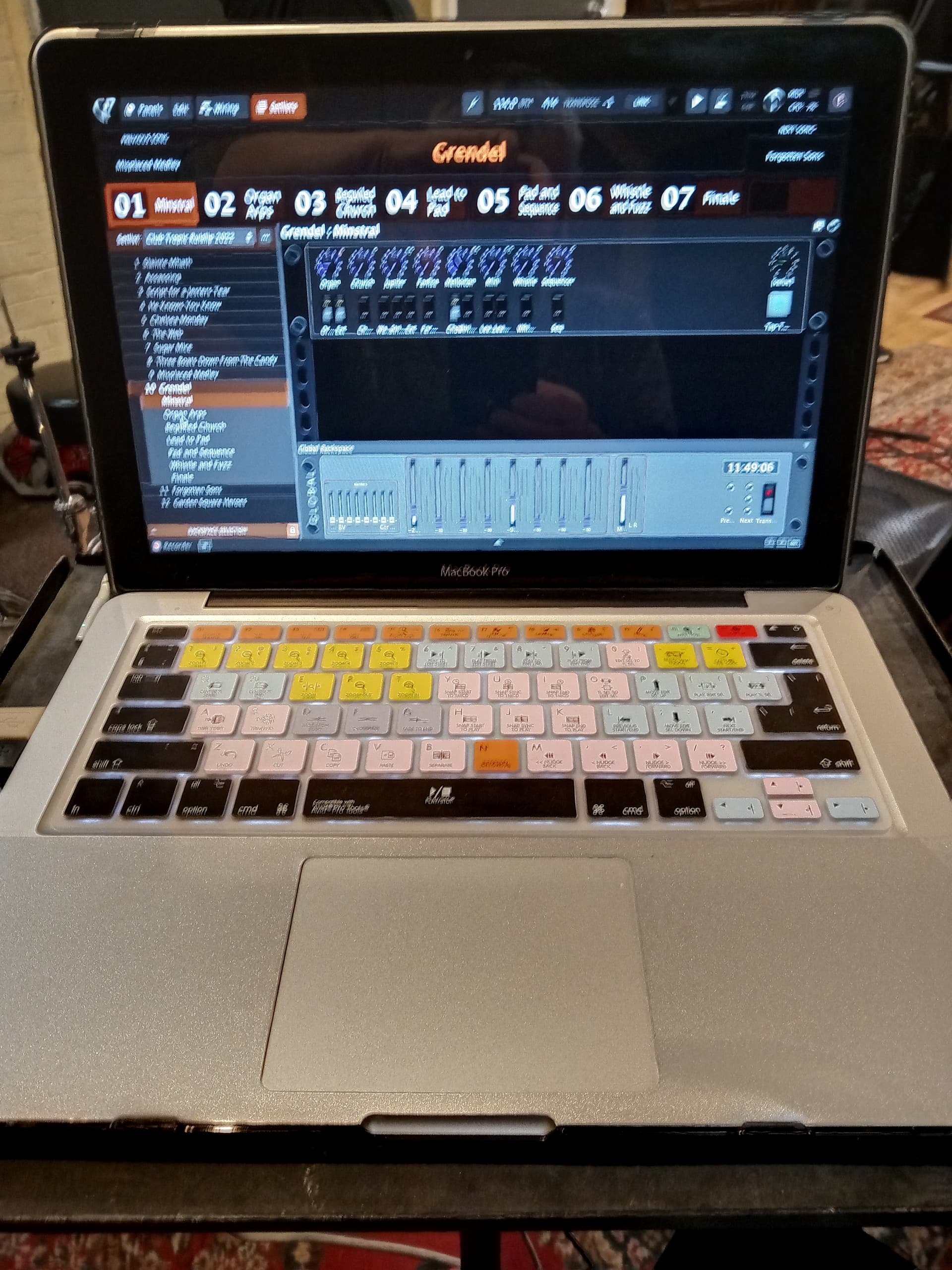
After close to two years, fighting Arturia memory leaks and Mainstages proprietary plugins. That, and with my steep learning curve to get GP as I would hope it could be, tomorrow morning is the day. I will be taking GP to its first rehearsal, with just over a month to its first gig. I will be taking my backup Mac with Mainstage on just in case, but this week it GP has played faultlessly on my Mac Pro and my MacBook Pro, even when I decided to use Rig Manager to connect the studio keyboards to my MacBook via Ethernet, it just kept on going. CPU usage is definitely lower than Mainstage, so this may keep the fans a bit quiter!!
Playing keys in a prog rock tribute band is never an easy call and requires such a complex setup some people will have been wondering why did it take so long, but with 18 minute long epics and 7 changes in a song, you have to get everything just right. Thanks for the people who make GP and support it on here, not something you get from the creators of that which will no longer be named. Tomorrow … here goes
The main reason it took two years was Arturia collection V6, memory leaks. My studio Mac Pro was running our of memory all the time. Even with 48GB it ran into trouble. It was after an upgrade to V8 that it all started making sense, suddenly stable, that was earlier this year, then it was build and testing. Moving a whole ruck of sounds from MS took an age until, I discovered MS had an Auto Sampler, then was just a few weeks to get the last of the sound over, a couple didn’t sample well.
The mapping for playing was entertaining as I made a lot of use of the dynamic split in MS, so had to take it slow to get the new hand positions, going back to MS to remap that so I got used to the new positions. Everything now runs on an 88 + 49.
What music? Fish era Marillion, this has been a big step up from my classic rock covers work, especially as it has some established Prog names in the band, not me I hasten to add.
Mark Spavin (Mark Kelly) Keyboards
Mark is an avid fan of the first wave of prog and electronic music and was a keen follower of the likes of Yes, ELP and Tangerine Dream.
So engrossed in this, he managed to miss the first age of Marillion! Mark started listening to Marillion in the post-Fish era, with the first Album being “Holidays in Eden”, and only ever seeing Marillion post-Fish.
On delving into the back catalogue, Mark came to love the early material and regretted not seeing the band live, with Fish at the helm.
An advert for a keyboard player, for a Fish era Marillion Tribute some years ago, put Mark in touch with Mark Colton. Work and other projects kept this from fruition at the time, but they stayed in touch. Mark Colton later joined Mark for a vocal dep., in a classic rock covers band.
This was followed by Mark being invited to join Mark Colton in TOMAHAWK KIDS (A ‘Sensational Alex Harvey Band’ Tribute).
The call to get a Marillion keyboard rig up and running was long waited, “I am thrilled to be part of MARQUEE SQUARE HEROES”.
Away from MSH, Mark plays keyboards with jobbing classic rock band FROM DUSK ‘TIL DAWN and has played keyboards on ‘Cruise To The Edge’ and at the ‘Prog On The Ranch’ festival in the USA, also playing at a pre-cruise party in Miami in front of many prog icons, including Carl Palmer, John Lodge, Steve Rothery and Neal Morse.
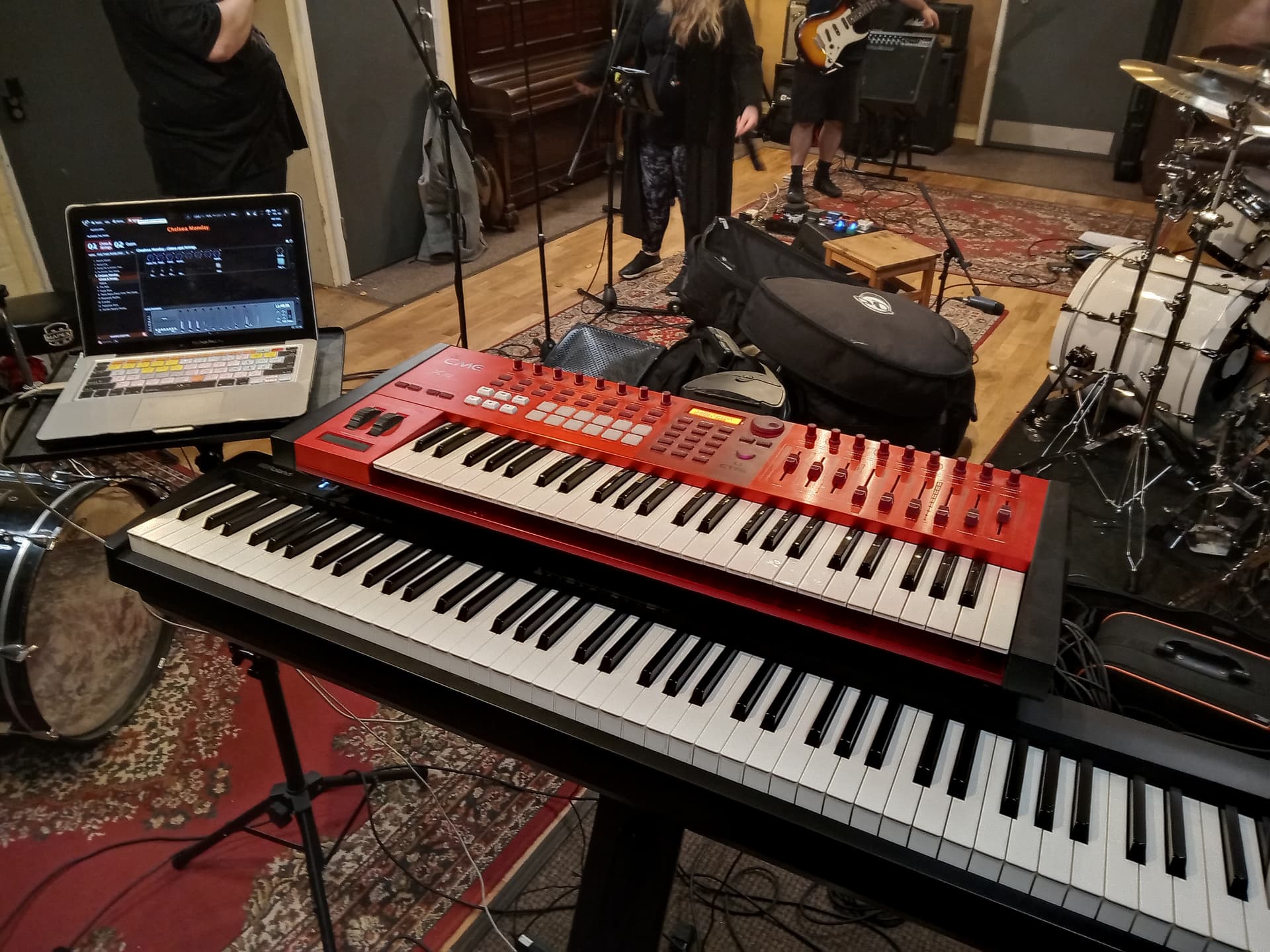
The CME VX5 has motorised faders, so the global rack space has a 16 channel mixer with the mixer faders mapped to these controls. These are sync’d so that moving the faders in the global rack space, the faders on the CME respond to the mixer position. Each rack space has widgets (rotary dials) mapped to the mixer volume faders in the global rack space, so that the mix setting from each rack space changes the fader positions on the CME. The faders bottom left of the global rack space are sending (not used at this rehearsal) OSC messages to an X18 used for monitor mixing for my IEM’s, they are mapped to the knobs top left on the CME.
The lower keyboard is a Roland FP10, I was shopping for a second controller when I played this in the shop while waiting, it has the ivory feel PHA-4 action, nothing else came close to how good this played. It was the right size and weight although it lacked controls (including aftertouch), the number of controls on the CME made up for the lack on the FP10. So this is one of the reasons the MIDI routing became a little more complex, as the pitch and mod wheels, expression pedal from the CME can also control the VST’s being played from the FP10 and the single sustain pedal from the FP10 works on the VST’s played from the CME.
One thing I have done in this rig is made sure that both boards work with factory reset settings, so this is MIDI channel 1 from each board, in the case of the CME, I select the Logic mode.
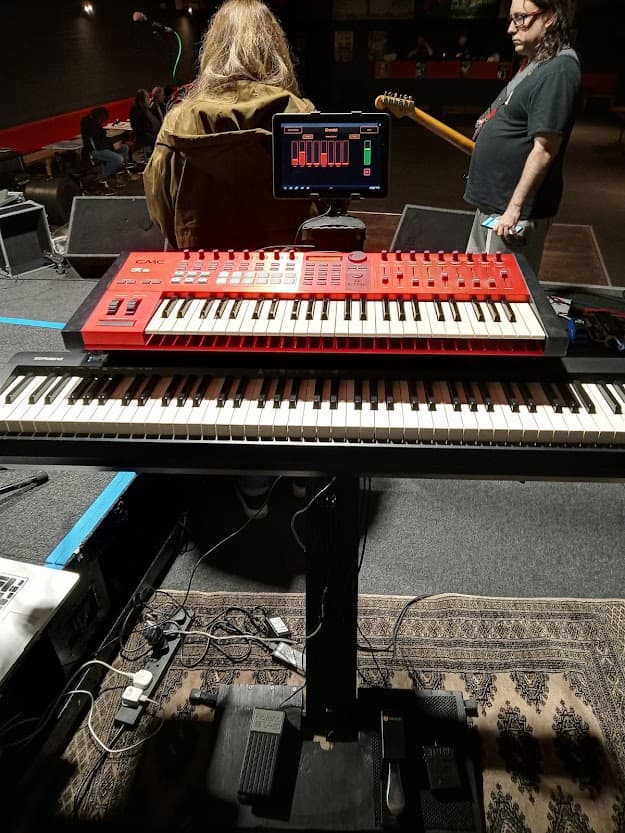
My intention is to move the MAC away from the front and put it behind me, the usual thing of confidence has stopped me from doing it so far. I will keep an OSC control panel on the rig so I can see song and part information. But when I am playing absolutely everything is controlled from the CME. We have walk on music and that is played from this rig, and started via OSC on a phone. We have WiFi on stage as it is used to connect everyone to the X18 so they can set their own monitor mix. I connect the MAC via ethernet and it can receive the OSC to select the song and play the walkon.
The Macbook no longer needs to be in view, I found on old Samsung tablet (must be at least 10 years old), this is mounted on a camera quick release mount. The next job is to build a rack mounted Mac Mini version with the router and PSU mounted to reduce the floor clutter.