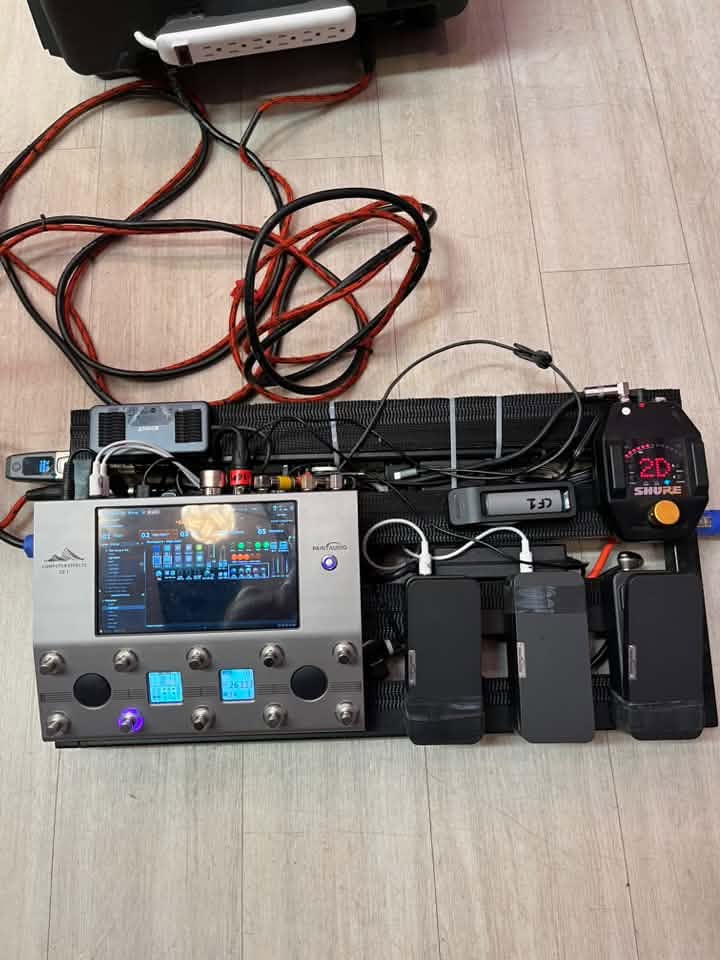
I’ve been gigging as a hobby in a 60/70/80s cover band for several years now using my Kronos 2 61 combined with 2 MIDI keyboards (NI Komplete Kontrol A61 and Arturia Keylab 61 Essential). All sounds come from the Kronos.
Goal: to remove the Kronos from this setup and replace it with a VST solution, because of the weight of the Kronos and the lack of a real successor in case of failures.
This the setup:
1 = Mic AKG D5 via XLR to Motu M4 Mic In 1 L
2 = Headphone Beyerdynamic DT 990 Pro to Moto M4 (only for home use)
3 = Keylab Essential 61 via MIDI to Moto M4 MIDI In
4 = NI Komplete Kontrol A61 via USB 2.0 to laptop
5 = Laptop (ASUS Vivobook s Flip TP3402VA-LZ062W) with Gig Performer & Arturia V Collection X via USB 3.2 to Motu
6 = Samsung Galaxy Tab A with MobileSheets via MIDI over USB to laptop
7/8 = L/R Motu Monitor or Line Out to in 1/2 Vol/Exp Pedal
9/10 = 1/2 out Korg XVP-20 Vol/Exp Pedal to stagebox
11 = stagebox out to IEM LD Systems MEI One
12 = wireless IEM transmitter to belt pack receiver
That one toggle widget is mapped to each of the bottom button rows; it pulls up the GUI for each VST.
Joe only uses 8 patches: CFX Grand, 2 Rhodes V8 patches – 1 straight, 1 “Ballad” – the Rhodes Wurli, the Clav Clone, 2 B3x patches for lower-manual comping – 1 clean, 1 dirty – and a classic Jupiter-8 horn patch.
He plays blues and classic R&R. He has all the GUI’s mapped to the front-panel controls so he can “fly” every VST live. It’s as KISS as it gets.
It is interesting to me how much more I use the Rhodes and the Wurlitzer than the standard piano, as tremendous as the CFX Grand is. The electric piano tones lend themselves to more spread voicings–tenths, drop-2’s, inversions with internal movement–and they not only cut through better, but they add so much more.
We don’t do anything tricky–tone-wise, anyway–I need the horns for things like Sweet Caroline, or whatever, and if the sax player comes up with something that I want to double on the spot. Classic sounds for classic tunes. In the old days, I’d have literally a ton of gear I’d be hauling to do this – a piano, a Rhodes, a Wurlitzer, a B3, a Clav, a synth. My whole rig weighs less than 40 lbs. including cases. I’m retired military; my back doesn’t handle it well. And even though this band has a roadie, it’s nice to be able to give him just a few cases that he can load onto a cart.
Best part about this is, the band has a roadie/soundman who’s built like a jackhammer operator or refrigerator mover, and he schleps your gear to and from the stage for you. He gets paid as a band member, but wow, money well spent.