This video showcases a hobbyist musician’s setup for live performances, featuring automation for audio, lighting, and sheet music.
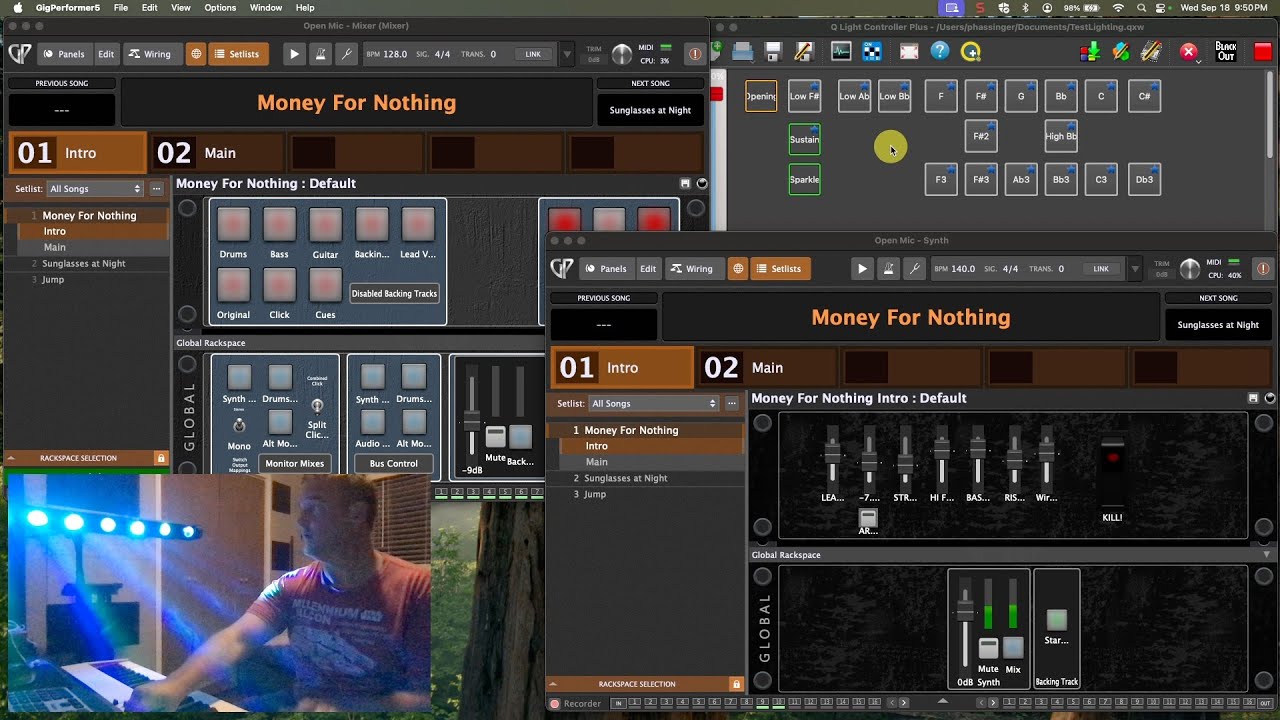
Key components of the setup include:
-
Lighting Control: The creator uses QLC+ (open-source) and discusses Obsidian Onyx to control DMX lighting, often triggering effects via MIDI notes (0:27-2:15).
-
Gig Performer: This serves as the core hub for hosting VST and AU plugins to generate synthesizer sounds. The creator demonstrates a multi-instance setup: one for instrument performance and another as a mixer for backing tracks, click tracks, and monitor mixes (2:30-13:00).
-
Automation: Gig Performer is used to automate song transitions, instrument changes, and even lyric page turns at specific points in a track (6:35-7:48, 13:05-14:20).
-
MobileSheets: Used for displaying lyrics and sheet music, receiving MIDI signals for wireless page turning (14:35-16:15).
-
Hardware: The setup utilizes an Arturia KeyLab MKII 88 controller and a Focusrite Scarlett 18i20 audio interface (2:50-5:53).
Throughout the video, the creator demonstrates these tools in action with songs like Money for Nothing and Sunglasses at Night, emphasizing the use of automation to manage complex live performance needs on a budget (16:40-23:07).
–
For the author of this video, Gig Performer is a game changer because it acts as a centralized, highly flexible hub that integrates complex live performance needs into a single workflow. Key reasons include:
-
Advanced Automation: It allows the creator to automate essential performance tasks—such as switching instruments, killing synth signals, and turning pages in MobileSheets—at precise moments during a song, removing the need for manual intervention (6:35-7:48, 13:05-14:20).
-
Multi-Instance Flexibility: By running a second instance of Gig Performer as a dedicated mixer, the user can manage backing tracks, click tracks, and monitor mixes for different band members, all while maintaining independent audio control (5:05-13:00).
-
Customizable Signal Routing: The Global rackspace feature allows for real-time, flexible re-wiring of audio paths. The author specifically highlights how they fixed issues like phase cancellation by routing signals through custom mono/stereo switches and gain controls (8:27-12:45).
-
Hardware Integration: It provides deep control over external hardware, allowing the author to map physical buttons and keys on their Arturia KeyLab MKII 88 to specific software functions, including song changes and lighting cues (13:05-14:20).